About the Journal
The CEPAM publishes a scientific journal dedicated to education and the arts every six months. The magazine is entitled Portuguese Journal of Arts Education [ISSN 2183-7481 or ISSN (print) 1647-905X] and its main purpose is to disseminate the results of investigations and projects carried out in the different artistic areas, as long as they are directed to the education.
The Portuguese Journal of Arts Education (RPEA) accepts articles on any subject in the field of artistic education, resulting from original research or essays, preferably in one of the following areas: Music Education, Dance, Theater, Fine Arts, Musicology and History of Art . Articles from all Portuguese Speaking Countries are welcome and, in case of special relevance, texts written in English can be accepted. Proposed articles may not have been the subject of any other type of publication. This restriction does not apply to press releases or abstracts published in the context of scientific meetings.
The RPEA provides immediate free access to its content, following the principle that providing free scientific knowledge to the public provides greater global democratization of knowledge. Thus, all articles are made available in an open, free and at no cost to the user.
Peer Review Policy
Submitted articles are initially evaluated by members of the editorial team and those deemed appropriate are submitted to the technical advice of at least two external reviewers, anonymously selected from the members of the RPEA Advisory Board (rather than Scientific).
The review is made anonymously, and reviewers may propose rejection, acceptance without modification or propose changes in content or form, conditional upon publication of the article.
Call for papers
The Portuguese Journal of Arts Education (RPEA) invites all interested parties to submit proposals for unpublished articles on any topic in the field of artistic education, resulting from original research or essayistic nature, preferably in the areas of Music Education, Dance, Theater, Arts Plastics, Musicology and Art History.
For the next volume, the RPEA also invites the submission of works for a thematic dossier on the curriculum and pedagogical strategies in the teaching of music, dance, theater, visual arts, musicology and art history.
Articles from all Portuguese-speaking countries are welcome and, in case of special relevance, works in English and Spanish may be accepted.
Proposals must be sent by October 30, 2024, to the email: carolinaedmusical@edu.madeira.gov.pt
For more information on publication rules, consult the website Policies.
Current Issue
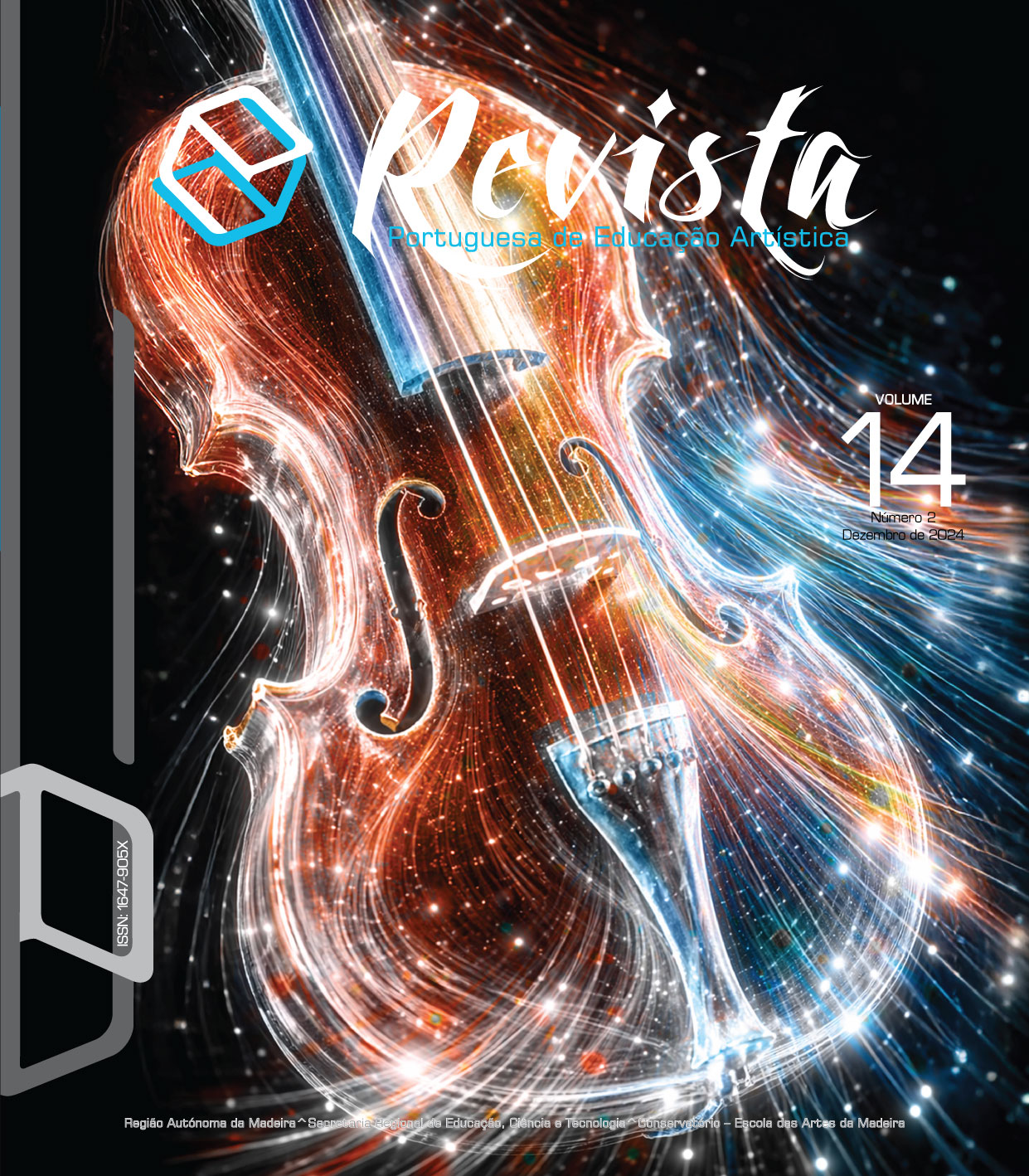
The latest issue of the Revista Portuguesa de Educação Artística brings together a diverse set of studies that highlight the vitality of contemporary thought around artistic practices and their educational contexts. Covering reflections on curricula, pedagogical experiences, artistic research, and technological integration, the contributions presented reveal shared concerns with the transformation of teaching methodologies and the role of the arts in fostering critical and sensitive development in individuals.
The issue opens with an analysis dedicated to Visual Arts and the implications of digital changes on artistic production and teaching. The article problematizes the need to update pedagogical practices in light of contemporary visual culture, offering a critical reading of the Portuguese curricular guidelines and advocating approaches that strengthen students’ creativity and visual literacy.
This is followed by a study focused on higher music education in Portugal, examining the curricular structures of undergraduate programs in Instrumental Performance. Through a comparative reading supported by quantitative and qualitative data, the text questions the balance between artistic practice, academic training, and professional preparation, pointing to challenges in creating more flexible musical pathways aligned with international trends.
In a register close to artistic research applied to pedagogy, the reflection turns to 26 Prelúdios Característicos e Concertantes para Violino Só by Flausino Valle. The article highlights the potential of these works for the technical and interpretive development of young violinists, emphasizing the dialogue between tradition and sonic experimentation present in the Brazilian composer’s writing.
Still within the scope of instrumental training, a study is presented on integrating the vihuela/viola de mão repertoire into classical guitar teaching. The research underscores the historical and pedagogical relevance of this repertoire, advocating its introduction in the early stages of learning as a way to expand technical and stylistic resources.
The performative and theoretical dimension of dance is explored in an article investigating the relationships between movement, notation, and archiving. Based on museological records of scenic dance, the authors reflect on alternative ways to inscribe artistic memory, proposing new readings of language, heritage, and choreographic documentation.
In the field of music education for early childhood, the pedagogical experience Max and Mia in the Wonderful Land of Music is presented, emphasizing the joint participation of children and families. The text highlights the potential of music as a social practice, underlining the importance of parental involvement in the affective, communicative, and artistic development of children.
Finally, the issue includes a study on the acceptance of technological tools in professional arts education, conducted in the context of a Portuguese conservatory. The research demonstrates how factors such as perceived usefulness, ease of use, and user attitudes influence the integration of digital technologies into artistic performance preparation.
This collection of contributions reveals an arts education in continuous dialogue with contemporary challenges, where tradition and innovation coexist and where research continues to play a key role in developing more critical, inclusive, and contextually grounded educational practices.